YouTube has 2.7 billion monthly active users, 114 million active channels, and only 35,000 of those channels have ever crossed a million subscribers. That's 0.03% of all creators. The difference between the channels that grow and the ones that stall comes down to the same handful of habits, repeated consistently, long after the early excitement wears off. Here are the five that actually move the needle, backed by 2026 data.
Schedule Content Creation and Batch It
Planning and organising your content process in advance sounds obvious until you realise how few creators actually do it. Most operate reactively: they film when inspiration strikes, edit when they have time, and publish when it's done. That produces the sporadic, unpredictable upload patterns that the algorithm specifically penalises.
Source: Influencer Marketing Hub, 2026 Creator Economy Report
The specific technique that separates the top creators from everyone else is batch filming: shooting 4-8 videos in a single session, then editing and scheduling them out over the coming weeks. This does two things. It decouples your upload schedule from your energy level on any given day, which is the single biggest reason most creators fall off their schedule. And it means your editor (or an editing service) has a steady queue to work through, rather than waiting on footage one video at a time.
- Plan 4-6 weeks of topics in advance: titles, angles, and rough scripts
- Batch-film on a fixed day each week or fortnight
- Schedule uploads for the same day and time each week, since audiences build habits
- Use a simple content calendar (Google Sheets, Notion, or Trello) to track status
Collaborate With Other Creators Strategically
Collaboration is one of the highest-leverage growth tactics on YouTube, but the creators who benefit from it most aren't just doing favours for each other. They're choosing collaborators whose audience overlaps with theirs in a specific, measurable way.
Source: Crescitaly YouTube Growth Strategy, 2026
For newer creators, the value is obvious: exposure to an established channel's subscriber base. But collaborations compound over time. Each creator learns from how the other approaches scripting, editing pacing, and audience communication, and those lessons show up in the quality of their solo work too.
Here's how to approach collaboration if you're still building your channel:
- Identify potential collaborators whose content complements yours: similar audience, different angle
- Research before reaching out, watching their recent videos, reading the comments, and understanding who their actual audience is
- Be specific in your pitch: propose a format, explain the mutual benefit, and outline what you'd create together
- Stay open to their ideas, since the best collabs adjust based on what works for both channels
- Set clear expectations upfront: who edits, where it publishes, timeline
On the editing side of collabs: collaborative content is often more complex to edit, with guest audio tracks, multiple setups, and cross-channel brand elements. If your editing workflow is already tight, this is where a dedicated editing service handles the complexity without slowing down your regular upload schedule.
Check Your Analytics, But Focus on the Right Numbers
YouTube Studio gives you more data than you can realistically act on. The mistake most creators make is either ignoring analytics entirely or obsessing over subscriber count, which is the least useful metric for diagnosing why a video performed the way it did.
Source: SocialChamp YouTube Stats, 2026
The three numbers that actually explain channel performance:
- Click-through rate (CTR): are your thumbnails and titles compelling enough that people click when YouTube shows them? Industry average is 2-10%; custom thumbnails increase CTR by 30-40% over auto-generated ones.
- Audience retention: what percentage of each video do people actually watch? Videos where viewers drop off in the first 30 seconds signal a weak hook; the algorithm uses this to decide how widely to distribute.
- Watch time: total minutes watched, which drives both algorithmic distribution and ad revenue eligibility more than any other metric.
Schedule weekly check-ins on these three, not daily obsessing and not monthly neglect. Look for patterns across videos, not individual data points. When something outperforms, work backwards to understand why before trying to replicate it.
Engage With Your Audience, Especially in the First 48 Hours
Every thriving YouTube channel owes its success to its community, not just its content. Top creators engage systematically, not occasionally. They respond to comments, host live Q&As, and use the Community tab to maintain a connection with subscribers between uploads.
Source: Crescitaly YouTube Growth Strategy, 2026
The engagement priority list for building a real audience:
- Reply to every comment in the first week, especially early on when you have the capacity
- Ask a specific question at the end of each video (not "like and subscribe," but a genuine question about the topic)
- Pin a comment that continues the conversation or adds context the video didn't cover
- Use Community posts to share behind-the-scenes content, polls, or teasers between uploads
- Go live occasionally: even short, low-production streams build the kind of connection that turns casual viewers into loyal subscribers
Stay Consistent and Use Short-Form as a Discovery Engine
Consistency is the most repeated advice in YouTube growth content, and it's repeated so often precisely because it's the hardest to maintain and the most reliably predictive of long-term success. But "stay consistent" has evolved in 2026. It no longer means just uploading regularly to one format.
Source: Loopex Digital, YouTube Shorts Statistics Q1 2026
The most effective consistency model right now is the Shorts-to-long-form pipeline: Shorts drive discovery (most views come from non-subscribers), and the best Shorts funnel viewers into your long-form content where the real retention, watch time, and monetisation happens. Creators who combine both formats grow roughly 41% faster than single-format channels.
The sustainability piece: the reason most creators fall off a consistent schedule is that editing is the most time-consuming step in the entire process. Filming a 15-minute YouTube video takes an hour. Editing it properly takes 8-15 hours. That math breaks down fast for any creator trying to maintain a weekly schedule while running a business, managing a channel, and doing everything else that makes good content possible. This is the problem a YouTube video editing service is specifically built to solve: your upload schedule keeps running whether or not you have editing time that week.
- Commit to a specific publish day and time, since the algorithm rewards predictability
- Post 3-5 Shorts per week as discovery hooks alongside your long-form output
- Batch-film to stay ahead of your schedule by at least 2-3 videos
- Outsource editing to remove the biggest single bottleneck to consistency
- Take planned breaks rather than burning out and going dark for a month
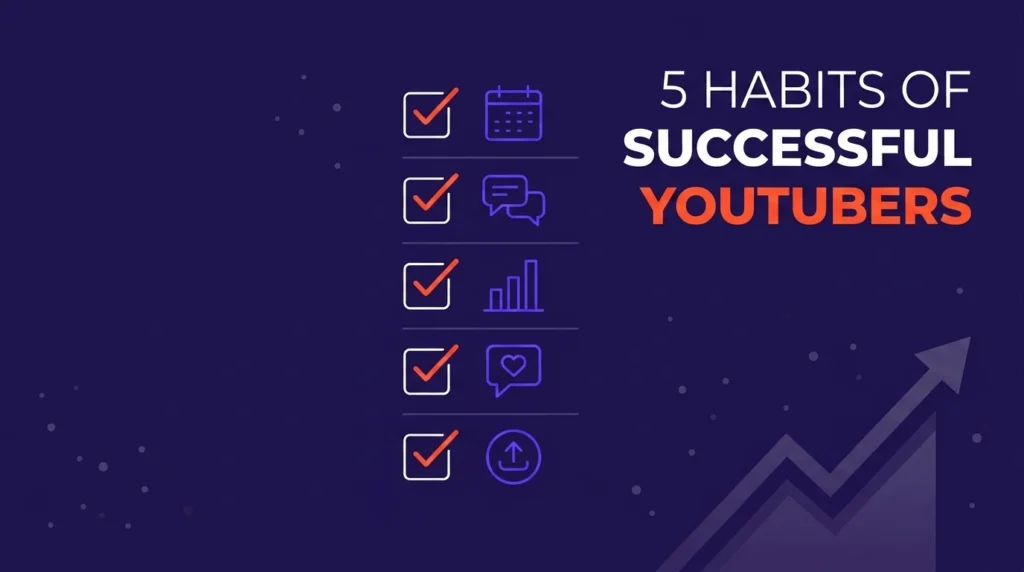
Quick Recap: 5 Habits of Successful YouTubers
| Habit | Key Action | Data Point |
|---|---|---|
| 1. Schedule & Batch | Plan 4-6 weeks ahead; batch-film to stay ahead of your schedule | 3.2x faster growth with documented strategy |
| 2. Collaborate | Partner with channels at 10-30% audience overlap | Long-term partnerships: 70% higher engagement vs. one-offs |
| 3. Track Analytics | Weekly check-ins on CTR, retention, and watch time only | 70% of YouTube views driven by the recommendation algorithm |
| 4. Engage Early | Reply to all comments in the first 48 hours after upload | Early view velocity in 48-72 hrs drives algorithmic distribution |
| 5. Stay Consistent | Weekly long-form + 3-5 Shorts; outsource editing if needed | +44% channel growth after 6 months of consistent Shorts |
FAQ
How often should successful YouTubers upload in 2026?
Most successful channels post at least once per week for long-form, plus 3-5 Shorts per week as discovery content. VidIQ's analysis of 5 million channels found that uploading 12+ times per month generates 66% more subscribers than posting 1-3 times monthly, though consistency matters more than raw frequency.
What's the single most important habit for YouTube growth?
Consistency: specifically, a predictable upload schedule combined with strong audience retention in the first 30 seconds of each video. Channels with consistent schedules see 50% more returning viewers, and returning viewers drive the watch time that powers algorithmic distribution.
How important are YouTube Shorts for channel growth in 2026?
Very. Creators who add regular Shorts to their long-form output see a 44% increase in channel growth over 6 months. Shorts primarily drive discovery (most views come from non-subscribers), which then funnels new viewers into long-form content where monetisation and retention happen.
How do successful YouTubers maintain a consistent upload schedule without burning out?
The two most reliable methods are batch filming (shooting multiple videos in one session so you're always ahead of your schedule) and outsourcing editing (which removes the most time-consuming step from the creator's plate entirely). Most creators who sustain weekly uploads for more than a year use one or both of these.
Which analytics should YouTubers check most regularly?
Click-through rate (CTR), audience retention, and total watch time, in that order. These three directly influence how widely YouTube distributes your videos. Subscriber count is a lagging indicator; these three metrics explain why your channel is or isn't growing.
The Editing Bottleneck Is the Easiest One to Remove
Every habit on this list becomes harder when you're spending 10+ hours editing every video yourself. A dedicated editor handles the cuts. You handle the content.
Book a Free 15-Minute Call →Or see pricing and our YouTube Consistency Report first.