Video is no longer a nice-to-have for agencies. Clients want short-form clips, YouTube videos, podcasts, ads, and social content, all at once.
And editing takes time.
In-house teams can only handle so much before deadlines start slipping.
That's why many agencies now turn to white label video editing. The right white label video editor helps you deliver more content without hiring more staff, and without your client ever knowing the work was outsourced. In this guide, we'll cover the best white label video editing services for agencies and what separates the good ones from the ones that create more work.
Let's dive in.
What Is White Label Video Editing (And Why Do Agencies Use It)?
White label video editing means a third party edits your videos, but the final product carries your agency's brand, not theirs. No watermark, no credit, no mention of who actually touched the footage. Your client only ever sees your agency.
For a video editor, white labeling is standard practice. The editor works inside your systems, follows your brand guidelines, and delivers files as if your in-house team produced them. Some agencies use a single white label video editor. Others build a small pod, still working invisibly, to handle higher volume across multiple clients.
The appeal is simple. You get production capacity without adding headcount, and your client relationship stays exactly where it already is, with you.
What Agencies Should Look for in a White Label Video Editing Partner
Most agencies pick editors like they pick freelancers: fast, cheap, hope for the best. That breaks later.
Start with system fit. Ask how they receive briefs, manage files, and track revisions, and confirm upfront that everything comes back fully white label. If onboarding feels messy, scaling will be worse.
Next, test consistency. Give them 2 to 3 content types, an ad, a short-form clip, a long-form video. Check if pacing, captions, and tone stay stable across all of them.
Turnaround time should be real, not marketing talk. Ask for fixed delivery windows and how they handle volume spikes. Good partners plan capacity. Bad ones guess.
Revisions matter more than edits. Look for structured feedback tools like timestamped notes, version control, and clear revision limits that don't reset chaos each round.
A video editing partner is only as good as what happens when something goes wrong: a bad brief, a missing editor, a vague note.
Now the overlooked stuff:
Check how they handle a bad brief. A strong partner asks clarifying questions instead of guessing. Weak ones just start editing and fix it later.
Ask what happens when an editor goes offline. If the workflow collapses with one person, you don't have a system. You have a risk.
Look at file discipline. Do they label versions cleanly, or send "final_final_v7"? It's a small detail but a big signal. If their labels are messy, chances are their editing process is too.
Test feedback memory. Good editors don't just fix edits. They remember your preferences across projects without being reminded every time.
Also ask if they batch similar work. Editors who batch cuts, captions, and sound together are faster and more consistent than those who edit start-to-finish randomly.
Finally, check how they say no. The best video editing partners don't agree to everything. They protect quality by pushing back when something will hurt the output.
Quick Checklist: What to Look for in a White Label Video Editor
Best White Label Video Editing Services for Agencies
Here are some of the best white label video editing services for agencies, reviewed and ranked below.
1. Editvideo.io, Best for Agency-Scale Consistency, Fully White Label
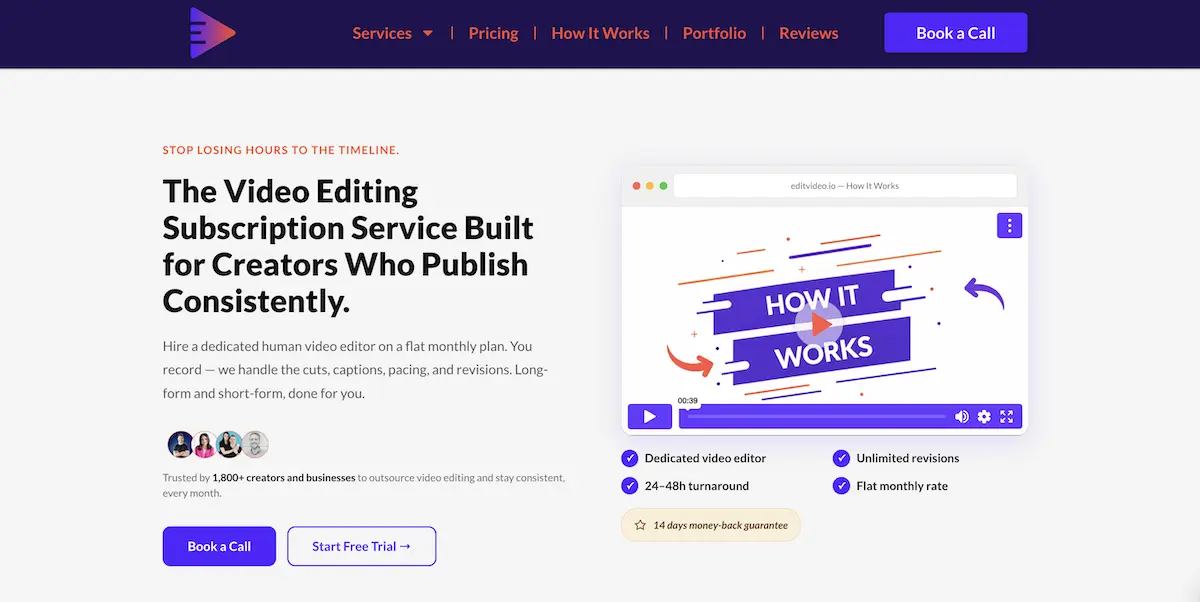
Built for agencies that need repeatable output, not one-off freelance wins.
Through Editvideo.io's dedicated full-time white label video editors and editor pods, every deliverable goes out 100% white label, no watermarks, no mention of a third party, no risk of a client finding out the editing was outsourced. Your agency keeps the relationship, the credit, and the margin. Editvideo.io stays in the background.
The real advantage on top of that is workflow memory. A dedicated video editor, or a senior-led pod if you're managing several accounts, doesn't start from zero every project. Over time, they learn your brand tone, pacing habits, hook style, and revision preferences for each client you manage. That means less explaining and faster first drafts that already feel "on-brand."
It also reduces decision fatigue: less re-teaching style, more focus on strategy while execution stays consistent. A dedicated full-time white label video editor starts at $2,950/month, or build a full pod, senior editor included, not billed separately, for $5,900 to $8,850/month across multiple accounts. Turnaround flexes by complexity: same-day for shorts, up to 2 long-form videos in 24 hours, and 24 to 48 hours for complex work, with unlimited revisions either way.
- You manage multiple client accounts with different brand voices
- You produce consistent weekly output across ads, Reels, or YouTube content
- You want fewer revision cycles because the editor already understands your preferences
- You're scaling content volume without increasing coordination overhead
- Your clients can't know editing is outsourced
- Whether they set up a proper SOP (style guide, references, editing rules) in the first week, not later
- How they separate and manage multiple client brands inside one system without mixing styles
2. Vidpros, Best for Structured Long-Form Content
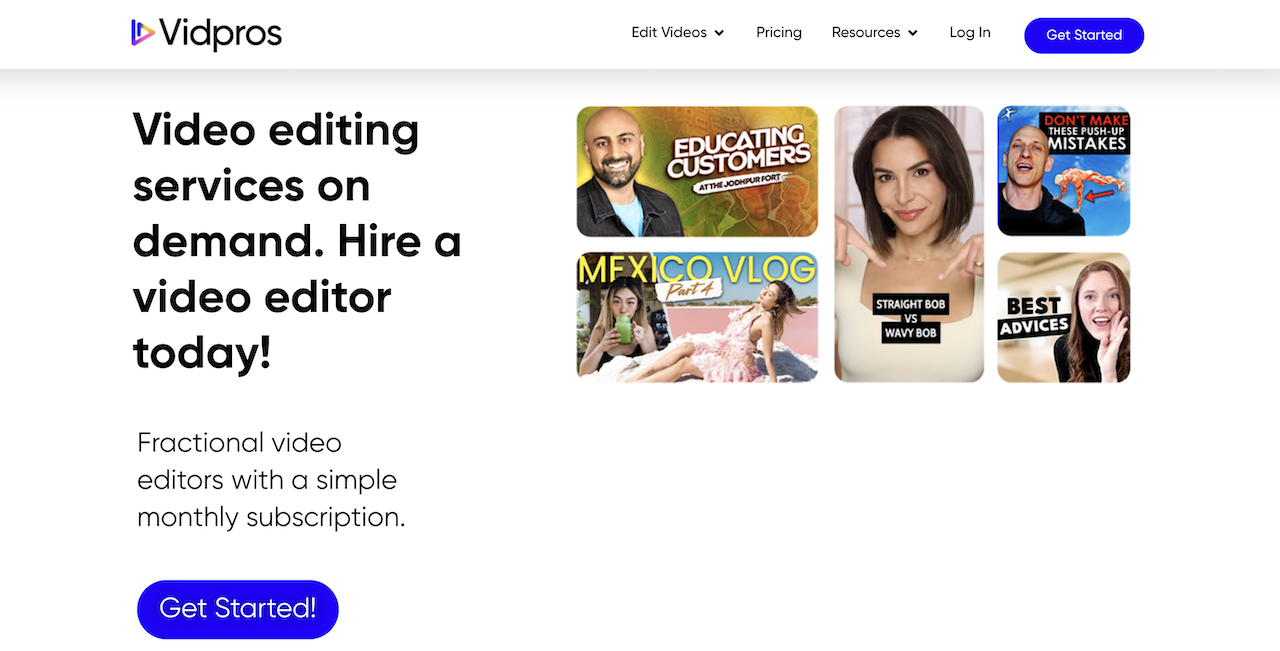
This is built for YouTube-first agencies where structure is the product. Not effects, not transitions, not visual flow.
Vidpros works best when your content has to hold attention over time. Think podcasts, educational channels, interviews, or thought leadership videos where clarity and pacing decide performance.
The strength here is narrative control. Good long-form editors don't just cut footage. They shape it. They decide where attention drops, where hooks are needed, and how to keep viewers moving through the story without feeling the edits.
- Build tight storytelling flow with clear hooks at the start and re-hooks throughout
- Improve retention pacing by removing dead space and tightening dialogue
- Handle chaptering, segmentation, and logical flow for long videos
- Clean up raw footage so it feels intentional, not recorded
- Whether they understand retention strategy, not just editing mechanics
- If they actively restructure content for clarity, or only cut based on instructions
- How they handle weak raw footage, do they improve the story, or just trim it
Best For: Agencies managing YouTube channels or creators at scale, where audience retention matters more than visual complexity.
3. BeCreatives, Best for High-Speed Short-Form Output
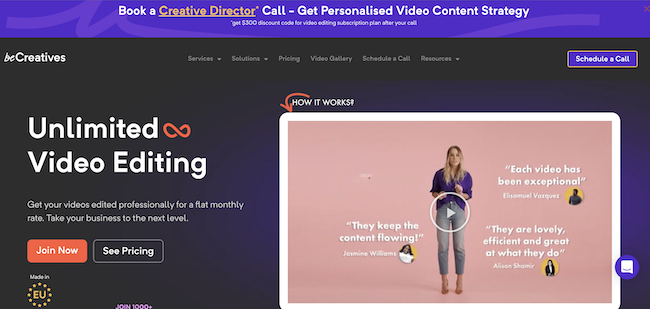
This is built for speed, not perfection. It fits agencies that live inside constant testing cycles, where the goal is to find winning creatives fast, not craft a single "perfect" edit.
BeCreatives is most useful when content is treated like an experiment. One idea becomes many variations. Hooks change. Pacing shifts. Captions get rewritten. The focus is iteration, not refinement.
The real value here is production velocity. Instead of spending days perfecting one video, you get multiple versions quickly, so you can test what actually performs in feeds.
- Rapid turnaround loops designed for ad iteration, not one-off edits
- Strong repurposing workflows that turn long-form content into multiple hook variations
- Caption-heavy editing built for silent autoplay environments like TikTok and Reels
- Retention-focused structuring that prioritizes the first 3 to 5 seconds of attention
- Whether they actually optimize for performance signals, not just making videos "look good"
- If they can systematically vary creatives without losing the core message
- How they handle feedback from performance data, do they iterate, or just deliver edits
Best For: Agencies running creative testing and A/B variations, not final production assets.
4. Video Husky, Best for Predictable Production Budgets
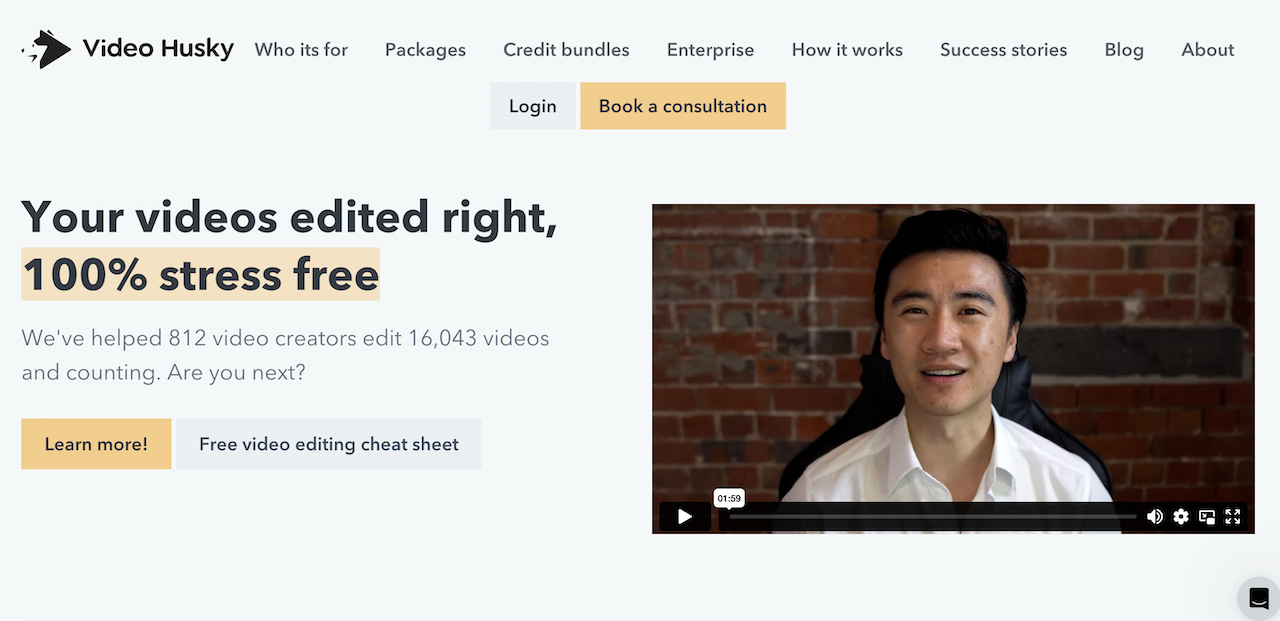
This is a subscription-style editing model built for stability. It works best for agencies that don't want surprise costs, shifting invoices, or per-project negotiation every time.
The core value is predictability. You're not buying "one edit." You're buying a fixed amount of editing capacity every month. That turns video production into a planned system instead of a reactive scramble.
But it's worth looking into what "unlimited editing" actually means in practice. Most unlimited-style plans process one video at a time, so output is paced rather than truly limitless.
Overall, it's less about creative flexibility and more about operational control. You know what you're getting, when you're getting it, and how it fits into your client retainers.
- Removes per-project pricing chaos and replaces it with a fixed monthly cost
- Makes it easier to forecast deliverables for client retainers and campaign planning
- Creates a stable baseline of output so teams aren't constantly firefighting production gaps
- Reduces decision overhead around "who to hire for what edit" every time
- Whether the subscription model can flex during demand spikes, or output is strictly capped
- If unused capacity rolls over or is lost
- How rigid their revision limits are when client feedback increases workload
Best For: Agencies with steady, repeatable monthly content requirements who value cost stability over high customization.
5. Fiverr Pro / Upwork, Best for Gap Filling, Not Systems
These platforms are useful, but they are not operating systems. You are not buying a workflow. You are hiring individual people who may or may not match each other over time.
That's the key difference. With agencies or managed services, the system stays consistent even if people change. On Fiverr Pro or Upwork, the system resets with every hire.
- One-off edits when you need something done fast and simple
- Specialized work like motion graphics, animations, or niche effects
- Emergency overflow when your main editor or team is overloaded
- Testing new creative styles before committing to a long-term partner
- No consistent editing style across different freelancers
- Repeating the same brand brief every time you hire someone new
- Quality shifts depending on who you get, even for similar pricing
- Limited ownership of your brand system or long-term workflow memory
Best For: Filling short-term capacity gaps, not building a production pipeline you can rely on long-term.
Is White Label Video Editing Legal?
Yes. White label video editing is a completely standard, legal business arrangement. You are paying for a service, and the finished files belong to you to use, brand, and deliver as your own work, the same way you'd treat output from an in-house employee or contractor.
The only thing to get right is your own contract with the provider: unbranded deliverables, no direct contact with your client, and confidentiality in writing. Once that's in place, it's simply outsourced production, no gray area.
How Much Does White Label Video Editing Cost for Agencies?
Cost is where most agencies get it wrong. They compare numbers instead of systems.
- Cheap per video or per hour upfront
- Hidden cost: time spent briefing and re-explaining
- Hidden cost: inconsistent output across projects
- Hidden cost: extra revisions that weren't scoped
- Fixed cost: salary, software, management overhead
- You pay full price even during downtime
- Demand isn't stable, but payroll is
- Best when volume is constant and fully utilized every week
- Predictable monthly cost
- Built-in scalability as client volume grows
- Faster turnaround cycles, less management load
- The value isn't cheaper editing. It's fewer operational leaks
Understand the Real Cost Equation
When choosing the best video editing partner for your agency, don't just ask "How much per video?"
Ask instead:
Because in agencies, editing cost is rarely about money. It's about speed, focus, and output stability.
Frequently Asked Questions
What is white label video editing?
White label video editing is when a third-party editor or team edits your videos, but the final files carry your agency's brand instead of theirs. There's no watermark, no credit, and no mention of the outside editor anywhere in the deliverable. Your client only ever sees your agency's name attached to the work.
Is white labeling legal?
Yes, white label video editing is a standard, fully legal business arrangement. It works the same way as any outsourced service: you pay for the work, and the finished files are yours to brand and deliver as you choose. The important part is putting a clear contract in place that covers unbranded delivery, confidentiality, and no direct contact between the editor and your client.
What is an editor pod?
An editor pod is a small team of dedicated editors, led by a senior editor, assigned specifically to your agency instead of a single person. It's built for agencies managing multiple client accounts or a higher volume of content than one editor can realistically handle. The senior editor sets the standard and reviews work before it reaches you, so quality stays consistent even as more people touch the account. With Editvideo.io, a pod runs $5,900 to $8,850 a month depending on size, with the senior editor included as your lead rather than billed as a separate cost.
How much does white label video editing cost for agencies?
It depends on the model. A single dedicated white label video editor typically starts around $2,950 a month. A full editor pod, built for agencies running multiple accounts, runs $5,900 to $8,850 a month. Freelancers can look cheaper upfront but usually cost more in hidden time: re-briefing, inconsistent output, and unscoped revisions. The real comparison isn't the sticker price, it's the total cost once you factor in how much of your own team's time gets absorbed managing the relationship.
Can my clients find out I'm using a white label video editor?
Not if you're working with a genuine white label provider. Deliverables should come back with no watermark, no branding, and no mention of the editor anywhere in the files or project names. A good provider also won't contact your client directly. The only way this becomes a risk is if the contract doesn't explicitly require unbranded delivery and confidentiality, which is why it's worth confirming both in writing before you start.
Whether you need a dedicated white label video editor for agency-scale work or a standard subscription for a single channel, Editvideo.io's video editing service is built around one dedicated editor per account, never a rotating pool.
Explore the Video Editing Service