Quick Answer
AI video tools can handle mechanical tasks like noise removal and transcription, but they can't replicate timing, storytelling, or brand intuition. We tested this directly with a 315-person study, and the result was more interesting than a simple "AI looks bad": most viewers couldn't consciously tell which video was AI-edited, yet they still engaged more and trusted more with the human-edited version anyway. For brands and creators who rely on video to build an audience or drive sales, that gap still shows up in the numbers, even when viewers can't name why.
AI is everywhere in 2026. Every week there's a new tool promising professional video in one click for the price of a coffee. And the demos look impressive, until you actually watch the output at full volume, with fresh eyes, as a customer would.
Most fully AI-generated video content has a tell, but it's not always a tell you can name. Sometimes it's the slightly-off timing. Sometimes it's the avatar mouth that doesn't quite sync. Sometimes it's just a vague feeling that nobody who cared about this brand made this video.
That feeling is the problem. And it's costing brands real money.
Our Own Research
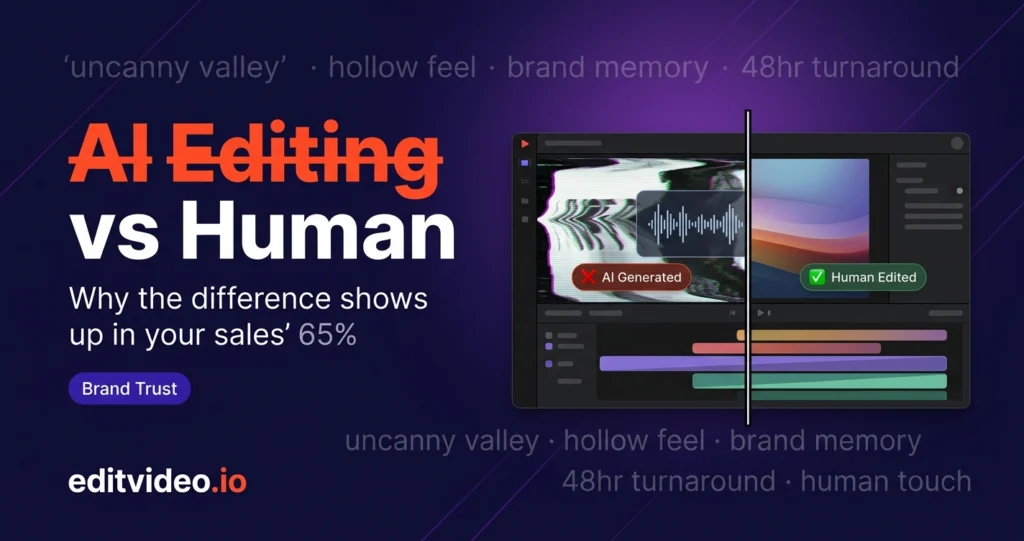
Rather than just make this argument, we tested it. We had the same script, filmed by the same creator, edited two ways: once by a professional human editor, once by an AI editing tool, using a single prompt with no manual touch-ups. Then we showed both versions to 315 people and asked what they noticed.
That last number is the interesting one. More than half of respondents guessed wrong when asked to spot the AI-edited video directly. But when asked which video they simply preferred, without any mention of AI at all, the human-edited version won decisively. People couldn't consciously name what was different. They responded to it anyway.
That's the exact pattern this article has been describing: audiences don't need to identify AI editing to be affected by it. See the full study, methodology, and both original videos side by side.
Full disclosure: editvideo.io is a video editing company, and we have an obvious stake in this comparison. We've published our full methodology, the raw questions asked, and both unedited findings, including the ones that don't flatter us, on the study page linked above.
The "Almost Human" Problem
There's a concept in psychology called the Uncanny Valley, the point where something looks almost human, but not quite, and triggers an instinctive feeling of unease. Robotics researchers discovered it decades ago. In 2026, it's showing up in brand videos, and now we have data showing the effect is measurable even when viewers can't consciously identify the cause.
AI-generated avatars, AI voiceovers, and AI-assembled ads increasingly fall into this zone. Technically capable. Visually close. The mouth moves slightly out of sync. The pacing feels mechanical. The "presenter" has no natural hesitation, no warmth, no moment where they look like they actually believe what they're saying.
⚠️ The trust problem: When a viewer watches a video and something feels off, even if they can't name exactly what, their brain files the brand under "suspicious." You're not just losing that sale. You're actively damaging the next one too.
The bar for "looks professional" is lower than most creators think. Audiences don't need Hollywood production values. They need to feel like a real person made this, someone who understands the product, the audience, and what actually matters to say. AI doesn't know any of those things about your brand.
4 Ways AI-Only Editing Hurts Your Brand
No emotional intelligence
AI can't hold a shot one beat longer to build tension. It can't time a cut to land with a punchline. It doesn't know when your brand voice calls for warmth versus urgency. It follows rules, and rules produce average.
Template sameness
Thousands of brands use the same AI tools and the same AI templates. The output is interchangeable, same pacing, same transitions, same visual language. Your brand becomes invisible in a feed full of identical-looking content.
Inconsistency between videos
AI tools start fresh every time. They don't remember that your brand uses a specific colour palette, a particular pacing style, or a consistent way of introducing products. Human editors carry your brand in memory.
Visual glitches erode trust
Warping backgrounds, disappearing fingers, plastic-looking hair, subtitles that don't match the speaker's energy, these micro-errors are immediately recognisable to audiences. They signal "this brand doesn't care enough."
Editing Is Rhythm, Not Just Cutting
What AI can't replicate
A great editor knows when to hold a shot for one extra second to let an idea land. They know when the music should drop to create a moment of anticipation. They can feel when a sequence is moving too fast for the emotional weight of what's being said.
AI follows rules. It finds the loud parts of the audio and cuts there. It applies "fast-paced" to every video because the brief said "energetic." But if every moment is emphasised, nothing is. If everything is fast, nothing feels exciting. Rhythm requires judgment, and judgment requires understanding your brand, your audience, and what you're actually trying to make someone feel.
This is the gap that separates videos that perform from videos that get skipped. Not production budget. Not fancy transitions. The ability to make a viewer feel something at the right moment, and trust that feeling enough to keep watching.
AI Video Tools vs Human Editing: The Real Comparison
Here's how the two approaches stack up across the factors that actually affect your content's performance:
| Factor | AI-only tools | Human editor (editvideo.io) |
|---|---|---|
| Brand consistency | Starts fresh every video | Dedicated editor remembers your style |
| Emotional timing & pacing | Rule-based, no intuition | Felt and adjusted per video |
| Storytelling | Clips in sequence, not narrative | Editor shapes a beginning, middle, end |
| Visual quality | Inconsistent, glitches common | Colour graded, stable, polished |
| Template originality | Same as thousands of other brands | Built around your brand specifically |
| Audience response (our study) | Only 53.3% correctly spotted as AI, but still less engaging and less trusted | Preferred on engagement (78.7%) and trust (63.2%) |
| Revision flexibility | Re-generate and hope | Unlimited revisions with context |
| Speed | Instant for simple outputs | 48-hour turnaround |
| Cost | Low upfront, hidden waste on unusable output | Flat monthly rate from $295/month |
How to Tell If Your Videos Have the "AI Feel"
Not sure whether your current content is triggering the trust problem? Run your last five videos through this checklist:
- ✕The Jell-O effect, backgrounds or objects warp slightly when the camera or subject moves.
- ✕Subtitles without energy, captions pop up in the middle of the screen with no relationship to the speaker's tone or pace.
- ✕The GPS narrator, voiceover sounds technically clear but completely flat, with no natural emphasis or personality.
- ✕Template fingerprints, remove your logo and the video could belong to any brand in any industry.
- ✕No brand memory, this video looks nothing like your last one. Different fonts, different pacing, different feel.
- ✕The hollow feeling, you watch it back and something feels off, even if you can't name exactly what.
Red flags your video looks AI-generated
If you ticked more than two of those, your content has the AI feel, and your audience is likely responding to it, even if they couldn't consciously identify it in a survey either.
Where AI Actually Belongs in the Editing Process
This isn't an anti-AI argument. AI tools are genuinely useful, when they're used as tools, not as the editor.
✕ Don't use AI for
- Creative decisions and pacing
- Brand voice and storytelling
- Emotional timing and music choices
- Anything that needs to feel human
- Building audience trust over time
✓ AI works well for
- Transcription and auto-captions
- Background noise removal
- Rough cut assembly from a transcript
- Colour correction pre-sets as a starting point
- Removing filler words from a recording
At editvideo.io, our editors use AI-assisted tools where they genuinely speed up mechanical tasks, noise removal, transcript generation, rough assembly. But every creative decision, pacing, structure, music, transitions, what to keep and what to cut, is made by a human editor who knows your brand. That's the foundation of our professional video editing service, and it's what produces content your audience actually responds to, even when they can't say exactly why.
The bottom line
If you spend $50 on an AI tool that produces a video nobody watches, you wasted $50. If you invest in a human editor who makes a video that builds trust, drives clicks, and closes sales, that video pays for itself. The metric that matters isn't the editing invoice. It's what the video does, whether or not anyone can explain why it worked.
Frequently Asked Questions
Can AI replace video editors in 2026?
For mechanical tasks like transcription, noise removal, and rough assembly, yes, AI tools handle these well. For creative decisions that require brand judgment, emotional timing, storytelling, and audience understanding, no. Our own 315-person study found viewers preferred human-edited video on both engagement (78.7%) and trust (63.2%), even though most of them couldn't consciously identify which video was AI-edited.
Is there real data comparing AI and human video editing?
Yes. We ran a 315-person study using the same script and creator, edited once by a human editor and once by an AI tool with a single prompt and no manual touch-ups. The human-edited version won on engagement and trust, while only 46.7% of respondents correctly guessed which video was human-edited. You can read the full methodology and watch both videos on our AI vs. human editing study page.
Are AI-generated videos good enough for social media?
For some use cases, simple informational clips, quick announcements, low-stakes content, AI-assisted video can be adequate. For content where you're trying to build audience trust, sell a product, or grow a channel, our own research suggests viewers respond less well to fully AI-edited work, even when they can't identify it as AI outright.
What is the Uncanny Valley in video editing?
The Uncanny Valley describes the unsettling feeling when something looks almost human but not quite right. In video editing, it appears when AI-generated avatars, voiceovers, or assembled footage produces content that's technically functional but feels hollow or off in ways audiences instinctively respond to, even if they can't identify exactly what's wrong. This feeling translates directly into reduced trust and lower conversion rates.
Is human video editing still affordable in 2026?
Yes. Subscription-based editing services like editvideo.io have made professional human editing accessible at a flat monthly rate from $295/month, which typically covers 4 long-form videos plus social reformatting. When you factor in the time saved, the consistency of having a dedicated editor who knows your brand, and the performance difference versus AI-generated content, human editing is often the more cost-effective choice.
How does editvideo.io use AI in its editing process?
We use AI-assisted tools for tasks where they genuinely improve speed without affecting quality, transcript generation, noise removal, rough cut assembly from a script. Every creative decision is made by your dedicated human editor: pacing, structure, music selection, transitions, colour grading, and what to cut. The goal is the best of both, efficient process, human creative judgment.
Human Editing. Professional Results. Flat Monthly Rate.
Dedicated senior editor, 48-hour turnaround, unlimited revisions, and free subtitles, all for a predictable monthly cost. Book a free call to see how it works.