Every creator eventually hits the same wall.
You start out editing your own videos. It works for a while. Then your audience grows, your upload schedule gets more demanding, and editing starts eating the hours you used to spend on the parts of the job that actually move your channel forward: scripting, filming, talking to your audience, building the next idea.
So you do what every guide tells you to do. You hire an editor.
And that is usually where the real problem starts.
The hidden cost nobody talks about
Most advice about outsourcing video editing focuses on time saved. Hand off the editing, get your hours back, grow faster. On paper, the math works. A creator posting a few times a week can easily lose 30 or more hours a month just sitting in a timeline. Valued at even a modest hourly rate, that is real money walking out the door every single month.
But here is what that math leaves out. Hiring a freelance editor does not eliminate that workload. It just changes its shape.
Instead of editing, you are now writing briefs. Instead of trimming clips, you are now chasing replies. Instead of one task, you have two: making content, and managing whoever is supposed to be helping you make it. For a lot of creators, that second job ends up being more draining than the first one ever was.
What I learned the hard way, before any of this had a name
I did not start out building a video editing company. I started out as a creator who needed one.
Back in 2019, I was running content for a brand and posting on the side, and I went through the exact cycle I am describing here, more times than I want to admit. I would find someone on a freelance platform whose portfolio looked great, send over footage and a brief, and get back something close to what I wanted. Close, but not quite. So I would send notes. Sometimes those notes landed. Sometimes the next delivery looked like it came from a different person entirely, because in a lot of cases, it had: the editor had subcontracted the work without telling me.
Then, without warning, the good ones would disappear. A reliable editor would go quiet for a week, then two, then I would get a message saying they had taken on a full-time job and could not continue. I do not blame them for that. Freelancing is unstable on their end too. But from where I was sitting, it meant starting over. Again.
I was not failing to find good editors. Good editors existed everywhere. What did not exist was a way to keep one, consistently, without either of us being a full-time employer or employee to the other.
At some point I stopped treating this as bad luck and started treating it as a pattern. That gap is the entire reason Editvideo.io exists. My co-founder Hassaan and I built the thing we wished we could have just paid for back when we were the ones stuck rebuilding a workflow every few months.
Editing skill was never the bottleneck
There is no shortage of talented video editors. Platforms like Fiverr and Upwork are full of people who genuinely know how to cut a video.
The bottleneck is something else entirely: consistency.
A freelancer who delivers great work this week might disappear next week. A new hire who interviews well might stop responding the moment a project gets demanding. Quality swings from one delivery to the next, because every editor brings their own habits, their own pacing, their own interpretation of vague instructions. Multiply that across a dozen projects a month, and what you get is not a content pipeline. It is a constant cycle of re-explaining, re-checking, and re-hoping.
This is the part of the creator economy that rarely makes it into the headlines. We talk about burnout from algorithm pressure and audience demands. We talk less about burnout from simply trying to keep a team of unreliable freelancers functioning month after month.
The math creators don't usually run
When a creator calculates whether outsourcing is "worth it," the calculation is almost always: hours saved on editing, multiplied by an hourly rate, compared against what an editor costs. That math nearly always favors outsourcing. But it is the wrong math, because it only counts the hours spent in the editing software itself.
It does not count the hours spent finding a freelancer in the first place — posting the job, sifting through portfolios that all start to look the same, scheduling intro calls, reviewing test edits. It does not count the hours spent re-explaining your brand's pacing and style to a new editor every time the last one moves on. It does not count the hours spent reviewing a delivery that missed the mark, writing detailed revision notes, waiting for the next draft, and sometimes discovering the next draft missed the mark in a completely different way.
Add all of that up over a year and the real cost of "cheap but unreliable" editing is rarely cheap. It is just a cost that gets paid in fragments small enough that no one stops to add them together. A few hours here vetting a candidate. An afternoon there rewriting a brief from scratch because the new editor cannot see the last twenty videos for context. A weekend lost because a delivery came back unusable three days before a launch. None of those line items show up on an invoice, which is exactly why they are so easy to underestimate and so expensive to live with.
Why "good enough" stopped being good enough
A few years ago, a passable edit was fine. Audiences were more forgiving, competition was thinner, and platforms rewarded almost anyone willing to show up consistently.
That window has closed.
Watch time standards are higher. Audience attention is shorter and more fragmented across platforms. The creators winning right now are the ones whose content looks and feels intentional, not improvised. In that environment, inconsistent editing is not a minor inconvenience. It is a ceiling on how far a channel can grow, no matter how strong the ideas behind it are.
At the same time, more creators are quietly stepping back from the "post everything, all the time" model that defined the last decade. There is a noticeable shift toward fewer, more intentional pieces of content, with quality doing more of the work that volume used to do. That shift only works if the production side of the business is dependable. You cannot build a sustainable, intentional content strategy on top of an editing process that breaks down every few weeks.
The real fix is not more freelancers. It is a different model.
The instinct, when one freelancer does not work out, is to go find another one. Post the job again, screen a new batch of applicants, hope this one sticks.
The problem is structural, not personal. Swapping one freelancer for another does not fix inconsistency. It just resets the clock on it.
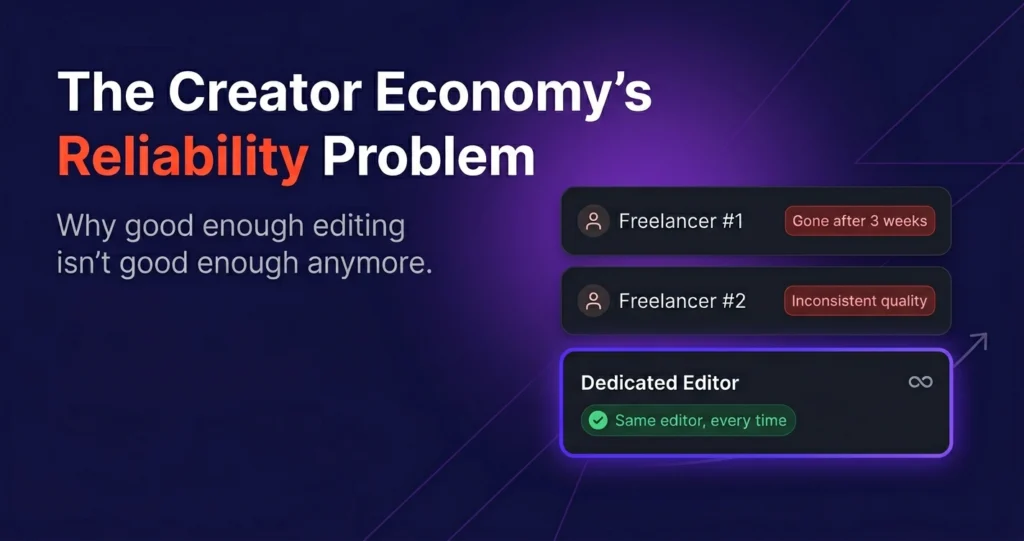
What actually solves this is removing the revolving door entirely. Instead of a rotating cast of strangers, a creator works with one dedicated editor who learns their style, their pacing, their audience, and their standards over time. The editor gets better at the channel the longer they work on it, the same way an in-house team member would, without the overhead of actually building an in-house team.
- A new editor every few months
- Re-explaining your style from scratch, every time
- Quality that swings delivery to delivery
- You manage the editor instead of the channel
- One editor, for the life of the relationship
- The editor already knows your pacing and style
- Quality holds steady, video after video
- You manage the channel, not the workflow
This is not a new idea borrowed from outside the industry. It is the model we built Editvideo.io around, because it is the model we wished existed back when we were the ones doing the hiring and getting burned.
What reliability actually looks like
For a creator, a reliable editing partner means a few concrete things:
What we actually see across 1,800 creators
Running Editvideo.io for six years has put us on the other side of a few thousand of these relationships, and a few patterns show up again and again.
The creators who grow the fastest are rarely the ones who switch editors the most trying to find someone "better." They are almost always the ones who found one good editor and stuck with them long enough for that editor to stop needing instructions at all. By video ten or fifteen, a lot of our clients stop sending detailed briefs entirely. They send raw footage and a one-line note, because the editor already knows what the channel sounds like.
The creators most likely to burn out are rarely the smallest or least experienced. They're usually mid-size creators who outgrew solo editing a year or two ago — but kept patching the gap with a new freelancer every few months instead of fixing it.
This is why we built in a backup system from day one rather than treating it as an afterthought. If a client's dedicated editor is ever unavailable, a backup editor with context on that account steps in, so a single point of failure never becomes a missed upload. It is a small operational detail, but it is the difference between a creator's worst week being a minor hiccup versus a missed publishing date that costs them momentum they cannot easily get back.
The bigger shift underway
The creator economy is not shrinking. It is maturing. The early years rewarded speed and volume above almost everything else. The next phase is rewarding the creators and businesses that build real infrastructure around their content, the same way any growing company eventually has to formalize the parts of the business that started out informal and improvised.
Editing is one of those parts. For a long time, it was treated as a task to delegate to whoever was available. Increasingly, it is being treated as something closer to what it actually is: a core part of the product a creator puts into the world, deserving of the same consistency and care as everything else they build.
Good enough editing got the creator economy this far. It will not be what takes it further.
Editvideo.io is a done-for-you video editing service that pairs you with one dedicated editor per client — never a rotating pool — with a 24 to 48 hour turnaround.
Book a Free Call