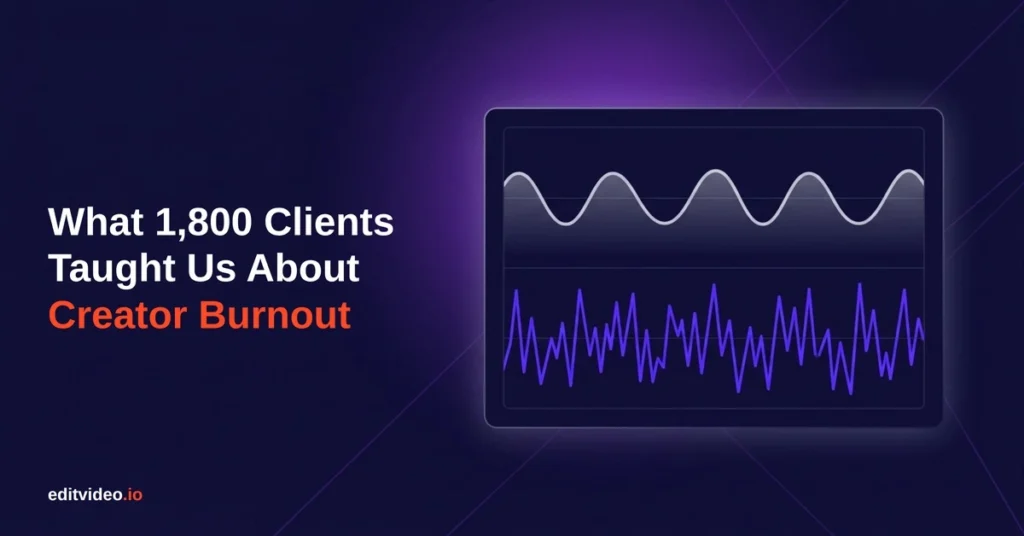
Over the past seven years, we have worked with more than 1,800 creators and businesses. We have seen channels grow from a few hundred subscribers to millions. We have watched creators land brand deals, quit day jobs, and build real businesses around content they started making in their bedrooms.
We have also watched a lot of creators burn out.
Not all of them in the way you would expect.
Most conversations about creator burnout focus on the obvious pressures: algorithm changes, audience demands, the grind of constant content output, the anxiety of watching a video underperform. All of that is real, and recent research backs it up. Recent industry surveys put burnout rates among full-time creators at over 60 percent, with the majority reporting heightened stress over content performance and a meaningful share dealing with financial instability tied directly to their work. Creators who have been in the game five years or longer report the highest burnout rates of all, which tells you something important: this does not get easier with experience. For a lot of people, it gets worse.
But after watching this play out across nearly two thousand client relationships, we noticed something that the general burnout conversation tends to miss.
A significant amount of creator burnout has nothing to do with creativity at all. It comes from operations.
Two kinds of exhaustion that get lumped together
There is creative burnout, and there is operational burnout. They feel similar from the inside, but they come from completely different places, and they need completely different fixes.
Comes from the actual work of being a creator. Coming up with ideas week after week. Performing on camera. Caring deeply about something that lives or dies by an algorithm you do not control.
What it needs: rest, boundaries, sometimes professional support. No business tool fully solves it.
Comes from the unglamorous, invisible work of running a content business: managing freelancers, chasing deliverables, redoing briefs, checking work that should have been right the first time.
What it needs: removing the instability at the source. Almost all of it is avoidable.
Here is the part that surprised us most working across so many client accounts: operational burnout is often mistaken for creative burnout. A creator says they are exhausted and considering quitting, and the assumption is that they have fallen out of love with making content. Often, what has actually happened is that they have fallen out of love with managing the production side of their own business, and that exhaustion is bleeding into how they feel about the creative work itself.
The pattern we kept seeing
Across thousands of client relationships, one pattern showed up again and again. The creators who struggled most were rarely the ones posting the most often. They were the ones carrying the most invisible operational weight.
A creator posting three videos a week with a dependable production process behind them was often in better shape, mentally and creatively, than a creator posting once a week while personally managing two or three freelance editors, chasing revisions, and redoing briefs that got misread. Output was not the deciding factor. Operational load was.
The complaint we hear most often beforehand is not "I am tired of making videos." It is "I am tired of managing people to make videos."
This shows up most clearly in what changes after a creator moves from managing their own freelance editors to working with a single dedicated editor who already understands their style. Once that operational weight is gone, something interesting happens. The creative energy that seemed to have disappeared often comes back, because it was never gone. It was just buried under hours of management work that had nothing to do with the actual craft of creating.
This lines up with something the research on creator burnout consistently shows. Creators who spend significant unpaid time on tasks outside actual content creation report meaningfully worse well-being than those who do not, regardless of how much content they are putting out. The hours lost to managing a broken production process are not neutral. They are actively corrosive, even when nobody names them as the source of the problem.
Why this gets missed so often
If operational burnout is so common, why does almost nobody talk about it this way?
Part of it is that creators are not trained to separate these two kinds of exhaustion. When you are deep in it, "I am tired" feels like one undifferentiated feeling. It takes some distance to recognize that the tiredness from writing a script is fundamentally different from the tiredness of following up with a freelancer for the third time this week about a deadline they already missed twice.
Part of it is that the advice creators usually receive does not help. Take a break. Set boundaries. Diversify your income. All reasonable advice for creative burnout. Almost useless for operational burnout, because the underlying problem is not too much creative output. It is a production process that demands constant supervision just to function.
And part of it is that creators often blame themselves for this kind of exhaustion. They assume that needing less hands-on management would mean they are not working hard enough, or that delegation that requires this much oversight is simply the cost of having help. From where we sit, having worked with this many creators, that is not delegation working as intended.
That is delegation creating a second, hidden job.
What actually changes the equation
We are not going to pretend there is a universal fix for creative burnout. The pressures that come from putting yourself in front of an audience, week after week, year after year, are real, and they deserve to be taken seriously on their own terms.
But operational burnout is a different category of problem, and it responds to a different kind of solution: removing the instability at the source, rather than helping someone cope with it better. In practice, that looks like a few specific shifts we have watched play out repeatedly:
The cognitive overhead of managing several different people, each with their own habits and reliability levels, disappears. One working relationship to maintain instead of several.
A huge amount of operational exhaustion comes from repeating the same instructions because each new freelancer starts from zero. An editor who has worked on a channel for months does not need that.
When quality varies wildly from one freelancer to the next, a creator has to personally quality-control every output. When the standard is consistent, that burden drops significantly.
None of these changes touch the creative side of the work at all. They simply remove the parts of the job that were never supposed to require this much energy in the first place.
A note on the creators who waited too long
One more pattern worth naming, because we have seen it often enough that it stopped feeling like a coincidence.
Creators tend to wait far longer than they should before changing how their production process works. They will tolerate an unreliable freelancer for months, sometimes years, because the alternative — going through the process of finding and onboarding someone new — feels like more work than just pushing through with what they already have. The irony is that the pushing through is usually costing them more time and energy than fixing the actual problem would.
This mirrors something the broader burnout research points to as well. Creators who have been active longest report the worst mental health outcomes, not the best. Experience does not appear to build resilience against this kind of grind. If anything, it builds tolerance for dysfunction.
A creator three years in might still flag a broken process as a problem worth solving. A creator seven years in has often stopped noticing it as a problem at all. It has just become the cost of doing the work — something to be endured rather than fixed.
We understand the hesitation. Changing how you produce content feels risky when your channel is your income. Nobody wants to disrupt something that is, on some level, still working. But "still working" and "working well" are not the same thing, and the gap between them is exactly where a lot of unnecessary burnout lives.
The creators who eventually do make the change almost universally describe the same feeling afterward: relief, followed by a kind of mild disbelief that they put up with the old way for as long as they did. Not because the new process is dramatically more sophisticated, but because it finally removes a category of stress they had quietly accepted as permanent.
What this means for the industry, not just individual creators
Zoom out far enough, and this pattern says something about the creator economy as a whole, not just about individual burnout stories.
The industry has spent the last several years building tools and advice around the creative and emotional side of burnout: take breaks, set boundaries, watch your relationship with metrics. Platforms have started rolling out wellness features and sabbatical programs. All of this is a genuine step forward, and creators deserve that kind of support.
But almost none of it addresses the operational layer underneath. A wellness week does not fix a broken production pipeline. A sabbatical does not solve the problem of an unreliable freelancer who disappears mid-project. These initiatives treat the symptoms of burnout without touching one of its quieter, more structural causes.
As the creator economy matures, the businesses and creators who last are likely to be the ones who treat production reliability as seriously as they treat content strategy. Not because operations are glamorous, but because the data, and our own experience across thousands of client relationships, both point to the same conclusion: a meaningful share of what gets labeled as creative burnout is really just an operational problem that nobody has bothered to fix yet.
The takeaway
If you are a creator who feels burned out and assumes it means you have lost your passion for making content, it is worth asking a more specific question first: is the exhaustion coming from the creative work itself, or from everything happening around it?
In our experience across nearly two thousand client relationships, that second category is far more common, and far more fixable, than most creators realize. The industry has gotten better at talking about burnout in the abstract. It still has a long way to go in helping creators tell the difference between the kind of tired that needs rest, and the kind of tired that just needs a better system.
Editvideo.io is a done-for-you video editing service that pairs you with one dedicated editor per client — never a rotating pool — with a 24 to 48 hour turnaround.
Book a Free Call