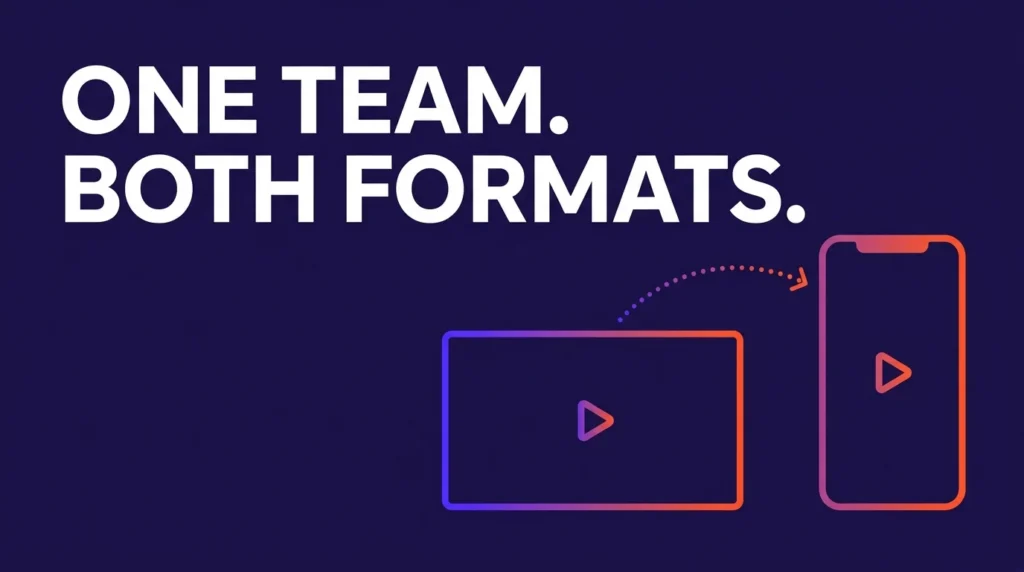
If you publish a weekly YouTube video and also cut it into Reels, TikToks, and Shorts, you've probably run into this problem: the editor who's great with long-form storytelling isn't always the same person who's sharp with short-form hooks and trends — so you end up juggling two freelancers, two invoices, and two onboarding conversations just to keep one channel running. That split matters more than it looks: channels that publish both long-form and short-form content grow roughly 41% faster than channels that only do one. The question worth asking isn't "who's the best editor," it's: which services actually handle both formats well, under one roof?
Why Long-Form and Short-Form Editing Aren't the Same Skill
Long-form editing — a 15-minute YouTube video, a podcast episode, a documentary-style brand video — rewards patience. A skilled long-form editor knows how to let a moment breathe, build a narrative arc, manage multi-camera angles, and color-grade a video so it feels cohesive over ten or twenty minutes. Retention pacing matters, but so does depth.
Short-form editing is the opposite instinct. A viewer scrolling TikTok or Reels hasn't chosen your video the way a YouTube subscriber has — it just appeared in their feed, and you have roughly three seconds to earn the next three. Short-form editors live and die by hooks, jump cuts, caption timing, and an instinct for what's currently trending on each platform. It's a fundamentally different muscle.
The data backs this up: short-form videos generate around 2.5x more engagement per impression than long-form content, while long-form content still wins decisively on SEO value, lead generation, and audience depth. Neither format is "winning" — they're built to do different jobs.
Engagement and growth figures based on 2026 video marketing and YouTube platform benchmark reports.
That's exactly why so many "we do everything" editors end up mediocre at one format while propping up the other — and why finding a service built to handle both, properly, is harder than it sounds.
The Problem With "We Do It All" Generalist Editors
A single generalist editor can technically cut both a long-form video and a Reel. Whether they're good at both is a different question. In practice, most editors lean toward one instinct — either the patient, story-first approach of long-form, or the fast, hook-first approach of short-form — and the other format ends up feeling like an afterthought. You'll notice it as flat pacing in your Shorts, or choppy, attention-deficit editing in your long-form videos.
This is also why the better agencies in this space don't ask one editor to be excellent at everything. They assign a long-form specialist and a short-form specialist to the same client, and use a creative lead to keep both consistent with your brand. The trade-off is usually coordination overhead — unless the service is structured to manage that for you.
Short-Form vs. Long-Form: What Each One Actually Wins At
Rather than picking a side, it helps to know exactly what each format is good for — that's the real argument for running both:
Short-Form Wins At
- Reach & discovery — most YouTube Shorts views come from non-subscribers, making it your top discovery channel
- Engagement rate per video (≈2.5x higher than long-form)
- Volume — more pieces published per month, more shots at virality
- Trend participation and algorithmic feed placement
Long-Form Wins At
- SEO value and organic search discovery over time
- Lead generation and deeper audience trust-building
- Monetization depth — longer watch time, more ad placements
- Audience retention and subscriber relationship strength
What to Look for in a Service That Covers Both Formats
Before you commit to any video editing service for both long-form and short-form content, run it through this checklist:
- 1A named editor per format — not "whoever's available that week." Ask who specifically edits your long-form videos and who edits your Shorts/Reels.
- 2A portfolio that proves both — most editors and agencies show you their best long-form reel or their best short-form reel, rarely both at a level you'd actually want. Ask to see real client examples of each.
- 3A brand-consistency process — style guides, brand notes, or a shared reference doc so your long-form intros and your short-form captions don't feel like they came from two different channels.
- 4Transparent, format-specific turnaround — long-form videos legitimately take longer to edit than a 30-second Reel. A service that quotes one blanket turnaround for both formats either isn't being honest, or isn't actually format-specialized.
- 5One point of contact, two specialists — you shouldn't have to manage two separate vendor relationships to get both formats covered. One account, one support line, even if two different editors are doing the work behind it.
The Smartest Workflow: Film Once, Edit Twice
If you're filming long-form content anyway — a podcast, a tutorial, a sit-down interview — the most efficient way to cover both formats isn't to film separately for each platform. It's to film once and let your long-form footage feed your short-form output: your editor pulls the strongest 30–90 second moments out of the long-form cut and reworks them into platform-native Reels, TikToks, and Shorts with their own hooks and captions.
This is also why a single, coordinated service tends to outperform two separate freelancers: your short-form editor already has full context on the long-form video, instead of waiting on you to send over clips and timestamps manually.
Worth noting: the line between formats is blurring. Platforms are pushing longer "short-form" (YouTube Shorts up to 3 minutes, TikTok up to 10) and a 2–5 minute "mid-form" zone is becoming its own category — needing enough structure to hold attention for a few minutes, but enough hook energy to survive a feed. A service that only thinks in two boxes (long vs. short) will increasingly miss this middle ground.
How Editvideo.io Covers Both Formats
We don't ask one editor to be everything to everyone. Long-form editing and short-form editing run as two separate, dedicated tracks — each with its own named editor assigned specifically to your account, not a rotating pool of freelancers:
| Format | Starting Price | What's Included |
|---|---|---|
| Long Form | From $295/mo | Dedicated editor, unlimited revisions, 24–48hr turnaround |
| Short Form | From $195/mo | Dedicated editor, unlimited revisions, 24–48hr turnaround |
You can subscribe to either one on its own, or run both at the same time under a single account — meaning you get the benefit of true format specialists without managing two separate vendors, two separate invoices, or two onboarding calls. If you're already filming long-form content, your short-form editor works directly from that footage, so there's no extra filming or briefing required to get your Reels and Shorts out the door. See the full pricing breakdown for plan tiers and what's included at each level.
One Generalist Freelancer
Cheaper upfront, but you're usually getting their stronger format and a weaker version of the other — and if they get busy or disappear, both formats stall at once.
Editvideo.io: Two Dedicated Tracks
A named long-form editor and a named short-form editor, both under one account, one support line, and one consistent brand process.
FAQ
Can one editor really handle both long-form and short-form well?
Some can, but it's the exception rather than the rule — the two formats reward different instincts (patient storytelling vs. fast hook-driven cuts). Most services that genuinely excel at both assign a specialist to each format rather than relying on one generalist.
How much does it cost to cover both long-form and short-form editing?
With Editvideo.io, Long Form plans start at $295/month and Short Form plans start at $195/month — see the full pricing page for tier details. You can run one or both, depending on what your content schedule needs.
Do I need two separate subscriptions to cover both formats?
You'll have one plan per format, but both live under the same account with a single point of contact — you're not managing two unrelated vendors.
Does running both formats actually help a channel grow faster?
Yes — creators publishing both long-form and short-form content see roughly 41% faster channel growth than those sticking to a single format, since short-form drives discovery (most views come from non-subscribers) while long-form deepens the relationship with viewers already paying attention.
Can I start with one format and add the other later?
Yes. Most clients start with whichever format they're struggling to keep up with, then add the second once the first is running smoothly.
Want one dedicated editor for your long-form content
and another for your short-form clips —
without juggling two separate vendors?
Or compare plans first on our pricing page.