You had a good idea. A strong hook. A topic your audience actually cares about. You uploaded it, checked back a few hours later, and... nothing. No spike. No algorithm push. Just a normal video, sitting at normal numbers.
The instinct most creators have at this point is to blame the idea. Maybe the topic wasn't interesting enough. Maybe the title needed work. Maybe it's just luck, some videos catch, some don't.
Here's what we've seen across thousands of videos we've edited for creators and businesses: the idea is rarely the problem. The edit is. Specifically, the first 30 seconds of the edit, and a handful of pacing decisions made (or not made) in the timeline, long before anyone hits "publish."
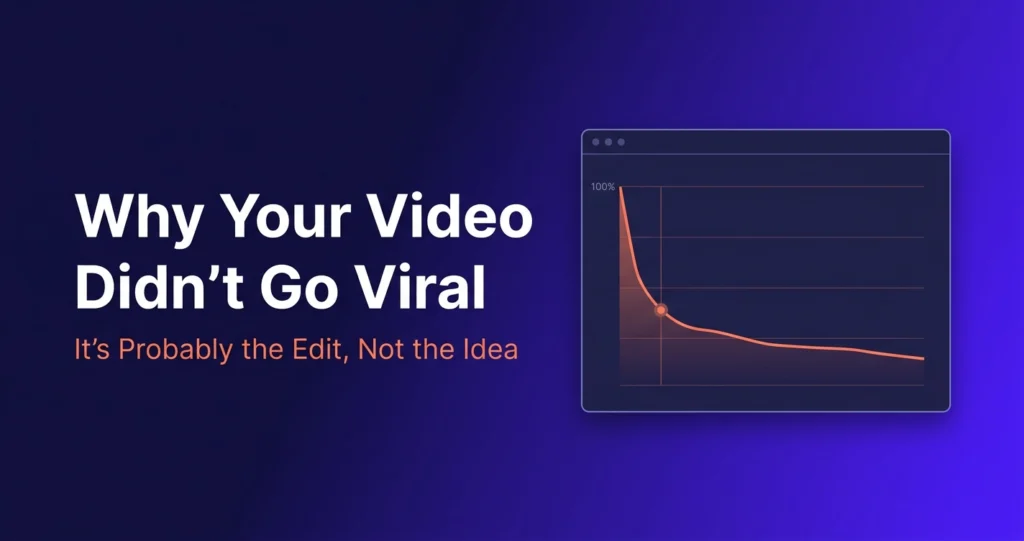
YouTube's algorithm in 2026 is, at its core, a satisfaction-prediction engine. It doesn't know if your idea was good. It only knows whether people kept watching. And the data above is consistent across multiple independent retention studies: the steepest drop in almost every video happens in the first 30 seconds, which means the edit, not the concept, is usually what decides whether a video gets a chance to go anywhere.
What the Retention Curve Actually Tells You
Open YouTube Studio's Audience Retention tab for any video that underperformed, and the shape of that curve tells a specific, diagnosable story, if you know what you're looking at.
A steep drop in the first 30 seconds, followed by a flatter line, means the hook failed, not the idea.
- The Cliff: a sharp drop in the first 15-30 seconds, then a flatter line. This means the opening doesn't deliver on the title's promise fast enough. The viewers who survive are engaged; most never get the chance to be.
- The Gradual Decline: a steady, even slope throughout. Usually a pacing problem: scenes running long, dead air between points, or visuals that don't change often enough to hold attention.
- The Spike-Then-Drop: a brief rise (people rewatching a moment) followed by an immediate fall-off right after. Something in that moment worked; whatever came right after didn't follow through.
Each of these is a different problem with a different fix, and all three are squarely editing decisions, not scripting or idea problems.
The Edit Mistakes That Actually Kill Virality
1. The Hook Takes Too Long to Land
A channel intro, a logo animation, a "hey guys welcome back", any of these pushed in front of the actual value costs you the viewers who were on the fence. The data is consistent: roughly a third of viewers decide to leave if the opening doesn't deliver within the first several seconds.
What kills it
Intro/logo before content. Restating the title instead of delivering on it. More than 15-20 seconds before any real value appears.
The fix
Cut straight to the payoff or the most interesting visual. Move branding to the end screen. Deliver on the title's promise inside the first 8-10 seconds.
2. No Pattern Interrupts
If the visual stays static, same angle, same shot, no graphics, no B-roll, for too long, attention drifts even when the content itself is decent. Editors who actively place a visual or audio change every 60-90 seconds give the viewer's brain something to re-engage with before it wanders.
What kills it
Long unbroken talking-head segments. No b-roll, zooms, or on-screen text breaking up the visual monotony.
The fix
A zoom-in, a cutaway, on-screen text, or a tonal shift at least once every 60-90 seconds, even a simple punch-in works.
3. Padded Length
Stretching a 6-minute idea into a 10-minute video, often for ad-break eligibility, reliably creates a sharp drop right around where the padding starts. Viewers can feel when a video is treading water, even if they can't articulate why.
What kills it
Repeating points already made. Slow-motion or extended b-roll with no new information. Filler dialogue before the next section.
The fix
Cut ruthlessly in review. If a section doesn't add new information or emotion, it doesn't survive the edit, regardless of runtime targets.
4. A Tangent or Pitch Mid-Video
A sharp drop at one exact timestamp, not a gradual slope, almost always means something specific happened there: a sponsor read, an off-topic tangent, or a section that felt irrelevant to what the title promised.
What kills it
Sponsor segments placed mid-value instead of after a natural beat. Tangents that don't connect back to the core promise of the video.
The fix
Place sponsor reads after delivering a complete value beat, not in the middle of one. Cut tangents in the edit even if they were fun to film.
How a Dedicated Editor Catches This Before You Publish
This is the part most creators don't have time for: watching their own retention graphs, diagnosing the pattern, and applying the right fix to the next video, every single upload, consistently, on top of everything else running a channel or a business requires.
It's also exactly what a dedicated editor does differently than a one-off freelancer or a generic editing pool. An editor who's worked on your last twenty videos isn't just cutting clips, they're watching for the cliff, the dead air, the missing pattern interrupt, before the video ever goes live. They learn your retention patterns the same way they learn your visual style.
This isn't just a hunch. We ran a 315-person study putting the same footage through a human editor and an AI editing tool, and viewers found the human-edited version more engaging by a wide margin, 78.7% to the AI version. The pattern-recognition and pacing judgment described above is exactly the kind of thing that shows up in numbers like that. See the full AI vs. human editing study for the details.
What to Check Before You Publish Your Next Video
- Does the actual value start within the first 8-10 seconds?
- Is there a visual or tonal change at least once every 60-90 seconds?
- Does every section earn its place, or is anything just padding the runtime?
- Are sponsor reads or tangents placed after a value beat, not in the middle of one?
- Have you actually opened the retention graph on your last 3 videos to look for repeating patterns?
"Most YouTube advice focuses on what happens before you hit record. The retention data says the bigger lever is what happens after, in the edit."
The Idea Was Probably Fine
If a video underperforms, the temptation is to throw out the topic and try something completely different next time. Often, that's the wrong lesson. The same idea, re-cut with a tighter hook, fewer dead spots, and intentional pattern interrupts, can perform completely differently, because the audience never actually rejected the idea. They rejected the experience of watching it.
Before you abandon a concept that didn't take off, pull up the retention graph and actually look at where people left. More often than not, the fix isn't a new idea. It's a sharper edit.
Stop Losing Viewers to Editing Mistakes
Get matched with a dedicated editor who learns your retention patterns, not just your visual style.
Get a Free Test Edit →Dedicated editor from day one · 24-48hr turnaround · From $295/mo · No contracts