You wouldn't think twice about paying a plumber $150 to fix a leak you can't fix yourself. You just want it done right, and done fast.
Video editing is the same way — except the price tag tends to stop people cold.
It's a fair question. And in this post, we're going to answer it with real numbers — not guesses.
You'll learn exactly what drives video editing costs, how to calculate ROI on every video you publish, and how a flat-rate video editing subscription service stacks up against freelancers and in-house hires.
By the end, you'll have a clear answer — and a framework you can use every month to measure whether your editing spend is paying off.
Step 1: Understand What You're Actually Paying For
Before you can judge whether any editing option is worth the price, you need to know what goes into every finished video.
Most people see the invoice total. They don't see the four cost layers underneath it.
| Category | What It Covers | Time / Cost Estimate |
|---|---|---|
| Editor Time & Skill | Rough cut, fine cut, audio sync, color grade, motion graphics & titles | 6–12 hrs per video Junior: $30–$50/hr Senior: $75–$120/hr |
| Software & Hardware | Adobe Premiere Pro, After Effects, DaVinci Resolve, editing workstation | $50–$150/month allocated per editor |
| Project Management & Revisions | Briefs, feedback loops, version control, client review rounds | +15–25% added to edit time |
| Overhead & Support | Storage, admin, insurance, file delivery | 10–20% of project cost |
When you add those four layers together, a single professionally edited 10-minute video costs somewhere between $400 and $700 when using a freelancer — before revisions.
What if you edit it yourself? The software cost is real, but the bigger cost is your time. While you're learning cuts and color grades, you're not filming, not publishing, and not selling. For founders and creators whose content drives revenue, that trade-off rarely makes sense.
Step 2: How to Calculate ROI on Every Video You Publish
You're not paying for videos. You're paying for results — leads, sales, subscribers, trust. So let's measure it that way.
ROI = (Value Gained – Cost) ÷ Cost × 100
A Real Example
You spend $500 producing a video. That video generates $3,000 in new sales over 90 days.
ROI = ($3,000 – $500) ÷ $500 × 100 = 500%
Now compare that to editing the video yourself:
- 3 hours editing (at $75/hr opportunity cost) = $225
- 1 hour planning & scripting = $75
- 1 hour recording = $75
- Tools = ~$17/month allocated
- Total: ~$392+ — and that's if you already know what you're doing
Most creators don't. And the editing quality shows — which affects watch time, which affects reach, which affects revenue.
The 3 Metrics to Track for Every Video
| Metric | How to Track It | Why It Matters |
|---|---|---|
| View-to-lead rate | Leads ÷ total views | Shows whether your video actually converts |
| Watch time (minutes) | YouTube or Instagram analytics | Platforms reward videos that hold attention |
| Cost per result | Total video cost ÷ leads or sales | Tells you if the spend was justified |
What Good Numbers Look Like
A $500 video gets 10,000 views. 1% convert to leads — that's 100 leads. Your team closes 10% → 10 customers at $500 average order value → $5,000 in revenue. ROI: 900%.
Now imagine publishing that video in two days instead of two weeks — because you're not editing it yourself. That's what outsourcing does. It compresses your content cycle, which compounds over time.
We've seen founders go from 2-minute average watch time to over 6 minutes — purely by cleaning up pacing, tightening audio, and adding supporting visuals. Retention isn't a content problem. It's often an editing problem.
Step 3: Flat-Rate Subscription vs. Freelancers vs. In-House — With Real Numbers
Here's where it gets concrete. Let's run the same scenario — 3–4 videos per month — across all three options.
Option 1: Freelancers (Per-Project)
The going rate for a mid-level freelance editor is $45–$80/hour. At $50/hour, a single 10-minute video looks like this:
- 4 hours rough cut = $200
- 2 hours fine cut & audio sync = $100
- 1 hour color grading = $50
- 2 hours motion graphics = $100
- Revisions (+25%) = ~$60–70
- Total per video: ~$510–$520
For 3 videos a month, that's roughly $1,530–$1,560 — and you're managing each project separately, chasing availability, and hoping the quality is consistent.
Option 2: In-House Editor
The average in-house editor salary in 2026 is around $70,000/year. Add benefits, software licenses, and hardware, and you're at roughly $91,000/year — or $7,583/month.
Even if you only need 10 hours of editing per month, you're still covering a full-time salary. And if they leave, you're starting over from scratch.
Option 3: Flat-Rate Video Editing Subscription
A video editing subscription service like editvideo.io gives you a fixed monthly rate — no hourly tracking, no project-by-project negotiation, no surprises on the invoice.
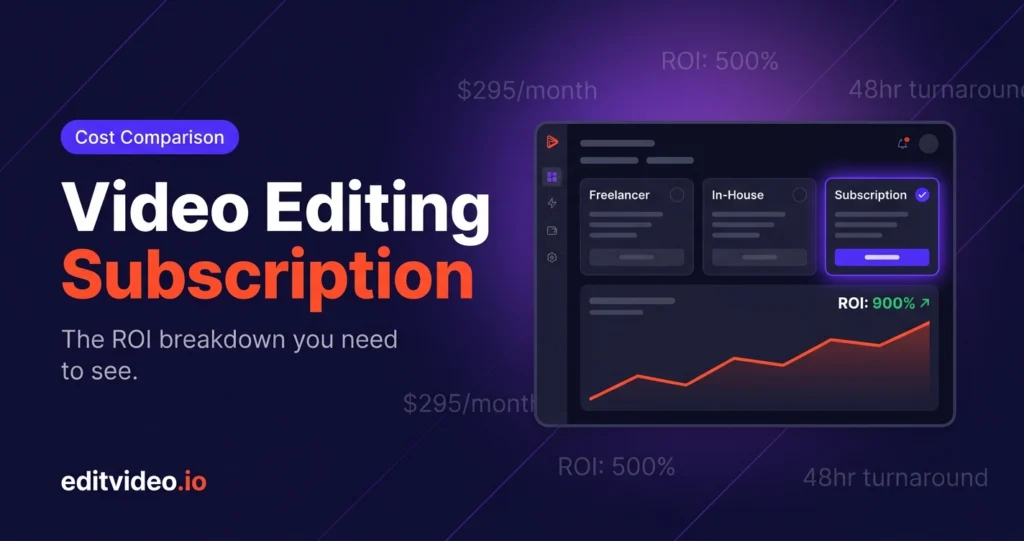
For $295/month, you get:
- 4 videos per month
- Dedicated senior-level editor
- 48-hour turnaround
- Unlimited revisions
- Free subtitles
- Social media resizing
- Premium stock footage & music
- 150GB cloud storage
- 14-day money-back guarantee
- Cancel anytime
Side-by-Side Comparison
| Freelancer (3 videos) | In-House Editor | Flat-Rate Subscription | |
|---|---|---|---|
| Monthly Cost | ~$1,530+ | ~$7,583 | From $295 |
| Editor Skill Level | Varies | High (if you hire well) | Senior-level |
| Turnaround | Unpredictable | Fast (if available) | Guaranteed 48 hrs |
| Management Effort | High | High | Low |
| Consistency | Low | High | High |
| Long-Term Value | Low | High | High |
When Does a Freelancer Actually Make Sense?
Freelancers are the right call in a few specific situations:
- You need a one-off project (a product launch video, a single ad creative)
- You need a highly specialized skill set — like 3D animation or broadcast motion design
- You're testing content before committing to a regular publishing schedule
But if you're publishing consistently — weekly YouTube videos, monthly case studies, ongoing short-form content — a subscription gives you better economics and far less overhead.
Frequently Asked Questions
What is a video editing subscription service?
A video editing subscription service is a flat-rate plan where you pay a fixed monthly fee in exchange for a set number of professionally edited videos. Instead of billing by the hour or project, the service gives you a dedicated editor, guaranteed turnaround times, and unlimited revisions — all for one predictable monthly cost.
How do I know if a subscription plan is worth it for my business?
Start with the ROI formula above. If the revenue or growth driven by your videos exceeds the monthly subscription cost — and it almost always does, once content is consistent — the plan pays for itself. Most creators see a positive return within the first 30–60 days.
Is a video editing subscription better than hiring a freelancer?
For most creators and founders publishing regularly, yes. A subscription gives you consistent quality, predictable pricing, and a dedicated editor who learns your style over time. Freelancers work best for one-off or highly specialized projects where you don't need ongoing volume.
What's a reasonable price for a video editing subscription?
Most reputable services range from $200 to $1,000/month depending on video length, volume, and complexity. editvideo.io starts at $295/month for 4 long-form videos — with unlimited revisions, subtitles, and stock footage included.
Can I cancel a video editing subscription if I'm not satisfied?
It depends on the provider. At editvideo.io, you can cancel anytime with no questions asked — and there's a 14-day money-back guarantee on your first month. Avoid any service that locks you into annual contracts without a trial period.
The Bottom Line
There are YouTube tutorials on how to rebuild a car engine. That doesn't mean you should do it yourself.
Video is the same. It's technical, it's time-consuming, and the difference between amateur and professional editing is visible in your analytics — lower watch time, lower retention, fewer conversions.
A video editing subscription service isn't a luxury. For any creator or founder who publishes regularly, it's the most cost-effective, lowest-friction way to stay consistent and keep your time focused on work that actually grows the business.
Start with one month. Measure the ROI. The numbers will make the case for you.
Try Your First Video — On Us
Senior-level editing. 48-hour turnaround. Unlimited revisions. Starting at $295/month — with a 14-day money-back guarantee.