If comparing two hourly rates is your entire decision process for in-house editor vs. outsourced service, your hiring system is already broken.
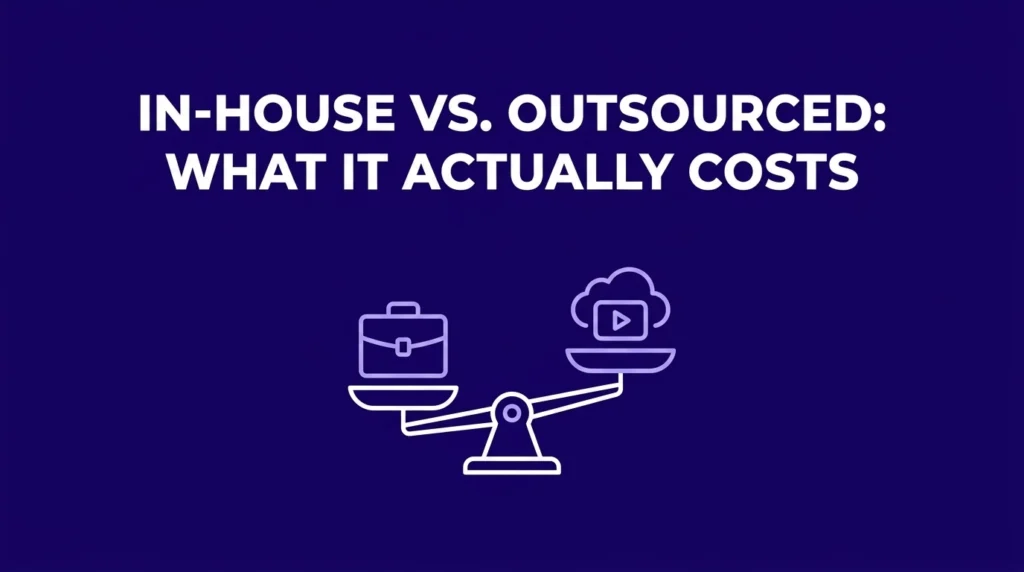
Money is not the only thing on the line. It is your time, your bandwidth, your current deadlines, and your future output. Basically, your business. Get it wrong, and you are not just out a salary, you also absorb the time and cost of recruiting, onboarding, training, and potentially starting the entire process over. This post cuts through the sticker price and lays out what "in-house editor vs. outsourced editor" actually costs.
TL;DR: in-house editor vs outsourced video editing service
| Factor | In-house editor | Outsourced service |
|---|---|---|
| Base cost | Salary plus benefits | Flat monthly fee |
| True cost | Higher than salary alone | More predictable |
| Time to start | Usually longer | Usually faster |
| Scalability | Fixed capacity | Can flex with demand |
| Risk if it does not work out | Higher commitment | Easier to switch |
| Best for | High, steady, predictable volume | Variable or growing volume |
Quick take: Outsourcing tends to make more financial sense for creators and smaller teams while editing volume is still variable. In-house starts becoming more attractive once your volume is large and consistent enough to keep a full-time editor genuinely busy.
Buying guide: 5 factors that actually decide this
1. Total cost, not just the rate
A $70,000 editor does not cost $70,000. Once you add benefits, software, equipment, storage, recruiting, and onboarding, the real annual cost can push toward $95,000 to $100,000 as an illustrative example. Compare that with an outsourced editing plan at $2,000 a month, which comes to $24,000 a year. Using those example figures, the gap is roughly $70,000 or more per year.
So the real question is not whether an in-house editor gives you more control. It probably does. The question is whether that extra control is worth the additional cost. For teams that do not have enough editing work to keep someone busy full time, it may not be. That is where a subscription-based video editing service can make more sense. You are buying editing capacity without taking on the full cost of another employee.
Cost advantage: outsourced.
Using the example costs above, outsourcing requires substantially less annual spend unless your workload justifies dedicated headcount.
2. Speed to get started
Hiring in-house means writing a job post, screening resumes, interviewing, making an offer, and onboarding. That is not a guess. SHRM's 2025 benchmarking report puts median time-to-fill at roughly a month and a half, around 44 days, for both executive and nonexecutive roles, and that is before training really begins.
An outsourced service removes most of that hiring process. Once you have chosen a provider, you can move directly into onboarding, sharing brand guidelines, and assigning the first project. If content needs to move this month, the hiring runway is a real cost, not a rounding error.
Speed advantage: outsourced.
3. Scalability during busy and slow seasons
An in-house editor has fixed capacity. During a launch or content sprint, that one person can become the bottleneck. During slower months, you are still paying the same salary even if editing demand drops.
Say your team normally produces 12 videos a month, but a launch pushes that to 30. One in-house editor does not suddenly gain extra capacity. You either delay content, bring in freelance help, or add another resource. Then the launch ends, you are back to your normal publishing schedule, and that extra capacity may no longer be necessary. That is the core problem with fixed headcount: your workload changes, your payroll does not.
With an outsourced service, you are buying editing capacity around the workload rather than trying to keep one employee perfectly utilized all year. This is why agencies with fluctuating client volume often use a video editing service built for agencies instead of repeatedly hiring around peak demand.
Scalability advantage: outsourced.
Particularly for agencies, growing teams, and businesses with seasonal content pushes.
4. Quality control and consistency
This is where in-house genuinely earns its cost. One dedicated editor who works only on your brand can learn your style, your shortcuts, your preferences, and your internal processes over time. Feedback loops can also be shorter because that person is already inside your meetings, Slack channels, and day-to-day workflow.
A good outsourced service can get close to that experience with a dedicated editor and clear brand guidelines, but it takes deliberate setup. It does not happen automatically just because you have handed someone the footage. The good news is that outsourcing does not necessarily mean getting a random editor every time. A dedicated video editor service can give you continuity while keeping the employment relationship external.
Consistency advantage: in-house.
Particularly when constant collaboration and deep brand familiarity are priorities.
5. Risk and management overhead
This is the cost most budgets miss. Recruiting itself costs money: SHRM's 2025 benchmarking report puts the average cost per hire at around $5,475 for a nonexecutive role. If the hire does not work out, you have also spent time interviewing, onboarding, training, and managing that person before restarting the process.
Outsourced services generally give you more flexibility to switch editors, change plans, pause work, or cancel without unwinding an employment relationship. And the management cost does not disappear when you make a good hire. Someone still has to assign projects, manage workload, review edits, handle time off and absences, maintain software and equipment, and figure out what happens when editing demand exceeds one person's capacity.
Outsourcing does not eliminate management either. You will still brief projects and review work. But a managed editing service takes much of the operational layer off your plate. Staffing the editor, maintaining the editing setup, and providing capacity are no longer entirely your problem. You are not just outsourcing editing, you are outsourcing part of the infrastructure required to keep editing moving. If reducing that operational load is the goal, it helps to compare the actual workflow rather than pricing alone. Here is how Editvideo.io's editing process works.
Risk advantage: outsourced.
The lower commitment generally gives you more room to change direction if the fit is not right.
The break-even point: when does in-house actually make sense?
Outsourcing is not automatically the better financial decision forever. At some point, your editing volume can become large and predictable enough that paying for outside capacity costs as much as, or more than, employing someone full time. That is the number you actually need to find.
Using the example above, outsourced editing at $2,000 a month costs $24,000 a year, compared with an estimated $95,000 to $100,000 annual cost for the hypothetical in-house editor. At that level, you are not choosing between two similarly priced options. You are potentially paying $70,000 or more per year to bring the function in-house.
That premium may be justified if you need an editor available throughout the workday, have enough work to utilize them consistently, require constant creative collaboration, or want editing expertise embedded inside your team. But if those things are not true yet, you are paying for capacity and control you are not fully using.
The hiring question, then, is not "can we afford an editor?" It is "do we have enough editing work to justify owning this function internally?" There is no single universal break-even point. For variable workloads, outsourcing tends to keep fixed costs lower. As editing demand becomes consistently high, comparing the annual cost of outsourcing with the fully loaded cost of an employee becomes the more useful exercise. Our breakdown of video editing subscriptions vs. freelancers covers a related version of this same tradeoff.
Before you hire, test one real editing cycle
Do not compare job listings with service pricing. Test the actual work. Give an outsourced editor the same type of footage and brief you would eventually hand to an employee. Then track three things:
- Output. How much actually gets published?
- Management time. How much of your team's time does the process consume?
- Quality. How much revision is required before the work is publish-ready?
If outsourcing cannot give you the consistency or control you need, you have learned that before committing to a salary. If it can, you may discover you did not need another employee. You just needed the editing off your plate.
Editvideo.io lets you test the quality first with a free 90-second test edit. That is separate from the 14-day money-back guarantee available on subscriptions. You can submit a test edit before deciding whether an ongoing editing service makes sense for your team. If you are weighing this against building an internal team instead, see our guide to hiring a full-time video editor for a look at the other side of this decision.
See what a dedicated editor actually costs.
Test the quality with a free 90-second test edit before deciding whether an ongoing editing service makes sense for your team.
Book a CallFrequently asked questions
Is an in-house editor ever cheaper than outsourcing?
Yes. In-house can become more economical when your editing workload is high and predictable enough to justify a full-time employee. Instead of relying on a generic number of editing hours per week, calculate how much you are currently spending on outsourced editing annually and compare that with the fully loaded cost of hiring an employee. If the numbers start converging and you have enough consistent work to keep an editor productive, bringing the role in-house becomes worth evaluating.
Can I switch from in-house to outsourced without disrupting my content schedule?
Yes, although the transition depends on how well your existing editing process is documented. Brand guidelines, project files, examples of approved edits, caption styles, motion graphics, export settings, and feedback history can all help an outsourced editor understand your existing style faster. The better the handoff, the less knowledge disappears during the transition.
What if I need both, someone in-house for strategy and outsourced help for editing volume?
That can work well. Your internal producer, content lead, or creative director can retain control over strategy and creative direction while an external editing team handles production capacity. It can be particularly useful when your team wants internal creative ownership without building an entire editing department.
How fast can an outsourced editor actually turn around content?
It varies by service and project complexity. Simple social edits may move relatively quickly, while long-form videos, complex motion graphics, multicamera footage, and revision-heavy projects naturally take longer. Check a provider's stated turnaround times for the specific type of content you are producing rather than assuming every outsourced service works at the same speed.
Do outsourced editors understand brand voice as well as an in-house hire?
They can, particularly when you work with a dedicated editor rather than a different person on every project. But outsourced editors need clear inputs. A strong style guide, approved examples, brand assets, editing preferences, and structured feedback can shorten the learning curve considerably. Over time, a dedicated external editor can build the same kind of pattern recognition that makes an experienced in-house editor valuable.