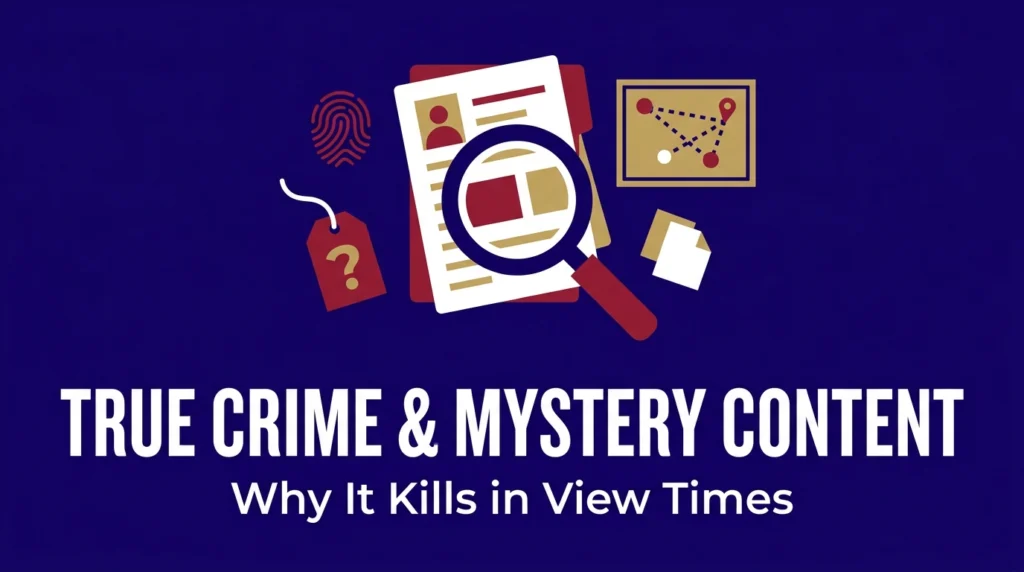
About 57% of Americans say they consume true crime content, and women take to the genre at a noticeably higher rate than men. If you've ever wondered why a podcast about a decades-old cold case can outperform almost anything else in your feed, you're not imagining it. In this guide, we'll unpack what true crime and mystery content actually are, why audiences can't look away, and where to find the creators doing it best right now.
What Is True Crime and Mystery Content?
True crime and mystery content cover a wide range of narratives, investigations, and storytelling formats, whether they're built on real events or fictional ones. Broadly, that includes:
- Criminal activity, documented or dramatized
- Unsolved cases and cold case investigations
- Fictional mystery and puzzle-driven plots
True Crime Content
True crime content focuses on real criminal cases, from infamous historical events to ongoing investigations. It usually involves detailed reconstructions, examinations of evidence, and interviews with law enforcement, victims, or sometimes the perpetrators themselves. The goal is to give viewers a clearer picture of motive, method, and aftermath, and a deeper understanding of both human behavior and the justice system.
Here's a good example of the format: a rundown of 18 murders that took more than a decade to solve. And here's a video that shows the format in motion.
Mystery Content
Mystery content leans more fictional, built around solving a puzzle, untangling a plot, or uncovering a hidden truth. It spans detective fiction, psychological thrillers, whodunits, and suspense dramas, from a classic Agatha Christie novel to a modern crime procedural. What holds the genre together is the promise that the answer is coming, just not yet, which is what keeps audiences guessing until the final reveal.
One of our favorite examples is Stephen King's 1408, built entirely around a hotel room that seems to drive everyone who enters it toward the same horrifying end.
Here's another example worth a look: a mystery-toned reel from @itsheidiwong on Instagram, which shows how well the genre translates to short-form video.
What True Crime and Mystery Have in Common
True crime and mystery differ in approach and subject matter, but the strongest examples of both tend to share the same building blocks:
Compelling, Complicated Characters
Whether they're real people or fictional creations, memorable characters carry both genres. Cunning detectives, calculating criminals, resilient survivors, and unsuspecting victims all drive the plot forward and give the audience someone to root for or against.
Twists and Turns
Both genres run on suspense and unexpected developments. A shocking reveal in a true crime documentary or a sudden plot turn in a mystery novel is what keeps viewers leaning forward instead of tuning out.
A Visible Investigative Process
Sometimes it's a journalist chasing new evidence, sometimes it's a fictional detective piecing together clues. Either way, watching the investigation unfold, not just the resolution, is what audiences are actually there for.
Social Commentary
The strongest true crime and mystery content uses the story as a lens on something bigger, justice, morality, or the nature of evil. That layer of commentary is often what turns a one-time watch into something people keep talking about.
Why Audiences Can't Get Enough: The Numbers
The public's appetite for this genre isn't a guess. Recent research backs up just how large and how engaged this audience really is.
Consumption Is Mainstream, Not Niche
According to a YouGov survey, 57% of Americans say they consume true crime content, with women reporting higher consumption (61%) than men (52%). Adults under 65 consume the genre at notably higher rates than older audiences too.
Podcasts Are the Genre's Biggest Engine
A 2024 consumer report from Edison Research and SSRS found that 84% of the U.S. population age 13 and older consumes true crime through some medium, 42% have listened to a true crime podcast, and 89% of weekly podcast listeners say they've binged the genre. Suspense, mystery-solving, psychology, and forensic science were the top reasons listeners gave for tuning in.
Social Media Keeps the Conversation Going
Platforms like TikTok, Instagram, and Reddit act as running commentary tracks for true crime and mystery fans, who dissect cases, speculate on suspects, and share their favorite creators under hashtags like #truecrime and #mysteryfiction. It's part of why a single case can stay culturally relevant for years after it's technically closed.
Streaming Keeps Raising the Bar
Netflix's "Making a Murderer," HBO's "The Jinx," and Hulu's "The Act" all proved there's a real audience for high production value, long-form true crime storytelling, not just quick-hit content. Their success has pushed the genre's overall production quality up across every platform.
Best True Crime YouTube Channels
BuzzFeed Unsolved Network
Hosted by Ryan Bergara and Shane Madej, BuzzFeed Unsolved Network blends humor with genuine intrigue, covering cold cases, supernatural phenomena, and historical mysteries while keeping the tone light enough to stay watchable.
Crime Junkie
Crime Junkie, hosted by Ashley Flowers and Brit Prawat, is one of the most consistently researched shows in the space, known for tight storytelling and in-depth case analysis.
Kendall Rae
Kendall Rae mixes true crime with conspiracy theories and paranormal investigation, and has built a loyal audience around her genuine curiosity and willingness to dig into lesser-known cases.
JCS: Criminal Psychology
JCS: Criminal Psychology takes a different angle entirely, analyzing real police interrogations from a behavioral and psychological standpoint rather than retelling the crime itself.
That Chapter
Hosted by Mike, That Chapter focuses on unusual and bizarre true crime cases, told in a conversational style that favors depth over speed.
Best Mystery YouTube Channels
Bright Sun Films
Bright Sun Films specializes in abandoned places and unsolved disappearances, backed by genuinely deep research into the history behind each location.
Nexpo
Hosted by Glink, Nexpo digs into dark internet mysteries, ARGs, and other obscure corners of online culture that rarely get mainstream coverage.
Night Mind
Hosted by Nick Nocturne, Night Mind breaks down web series and ARGs with a level of narrative analysis you won't find anywhere else.
Criminally Listed
Criminally Listed recounts mysterious disappearances and unsolved murders with a straightforward, fact-first approach that lets viewers draw their own conclusions.
Lutch Green
Lutch Green covers everything from paranormal encounters to government cover-ups, mixing narration, interviews, and archival footage with a healthy dose of skepticism.
Turning the Genre's Popularity Into Your Own Content
With well over half of Americans engaging with true crime in some form, there's a real audience waiting for well-made content in this space. But an oversaturated genre also means the bar for production quality keeps rising. A strong hook in your first few seconds matters more here than almost anywhere else. Our guide on writing YouTube intros that actually hook viewers is a good place to start.
Once the hook is working, the next challenge is holding attention through a story that unfolds over several minutes. A tight script written for how footage will actually cut together makes a bigger difference than most creators expect. Our guide on writing a YouTube script your editor can cut fast covers exactly that, and our broader piece on video storytelling digs into why narrative structure matters as much as the facts themselves.
Editing is where true crime and mystery content lives or dies. Pacing, sound design, and how you time a reveal against a cut can be the difference between a video someone finishes and one they abandon halfway through. If you want more ways to keep viewers watching, our post on making YouTube videos more engaging is worth a read.
FAQs: True Crime and Mystery Content
Why is true crime content so popular right now?
Research from YouGov and Edison Research shows true crime consumption is genuinely mainstream, not a niche interest. Audiences are drawn in by suspense, the visible investigative process, and the social commentary woven into the best examples of the genre.
What's the difference between true crime and mystery content?
True crime is grounded in real criminal cases and investigations. Mystery content is usually fictional, built around solving a puzzle or uncovering a hidden truth. Both genres lean on similar storytelling techniques, which is why they're often grouped together.
Do women really consume more true crime content than men?
Yes. A 2024 YouGov survey found 61% of women report consuming true crime content compared to 52% of men, a gap that's been consistent across several independent studies.
What makes true crime videos hard to produce well?
The genre depends heavily on pacing and reveal timing. A strong story can still fall flat if the hook is weak or the edit doesn't build tension at the right moments, which is why scripting and editing matter as much as the research behind the story.
If you're building true crime or mystery content and want an editor who understands pacing, tension, and how to hold a reveal, our YouTube video editing service pairs you with a dedicated editor who can help your story land the way it's supposed to. You can also see the full range of what we offer on our video editing service page, starting with a free test edit.